Jue, 9 may, 2024

masters’ talks

19.30 h — Evento en el DHub

Abierto al público

Eyal Weizman, Forensic Architecture

Ungrounding

Eyal Weizman es fundador y director de Forensic Architecture y profesor de Culturas Espaciales y Visuales en Goldsmiths, Universidad de Londres, donde en 2005 fundó el Centre for Research Architecture. En 2007 creó, con Sandi Hilal y Alessandro Petti, el colectivo arquitectónico DAAR en Beit Sahour/Palestina.

Es autor de numerosos libros, entre ellos Hollow Land, The Least of all Possible Evils, Investigative Aesthetics, The Roundabout Revolutions, The Conflict Shoreline y Forensic Architecture.

Eyal ha ocupado cargos en numerosas universidades de todo el mundo, como Princeton, ETH Zurich y la Academia de Bellas Artes de Viena.

Es miembro del Consejo Asesor de Tecnología de la Corte Penal Internacional y del Centro de Periodismo de Investigación.

En 2019 fue elegido miembro vitalicio de la Academia Británica. En 2020 recibió un MBE por «servicios a la arquitectura» y en 2021 el London Design Award. Forensic Architecture ha recibido el Premio Peabody de medios interactivos y el Premio de Cultura de la Fundación Europea de la Cultura.

Eyal estudió arquitectura en la Architectural Association, donde se licenció en 1998. En 2006 se doctoró en el London Consortium de Birkbeck, Universidad de Londres.
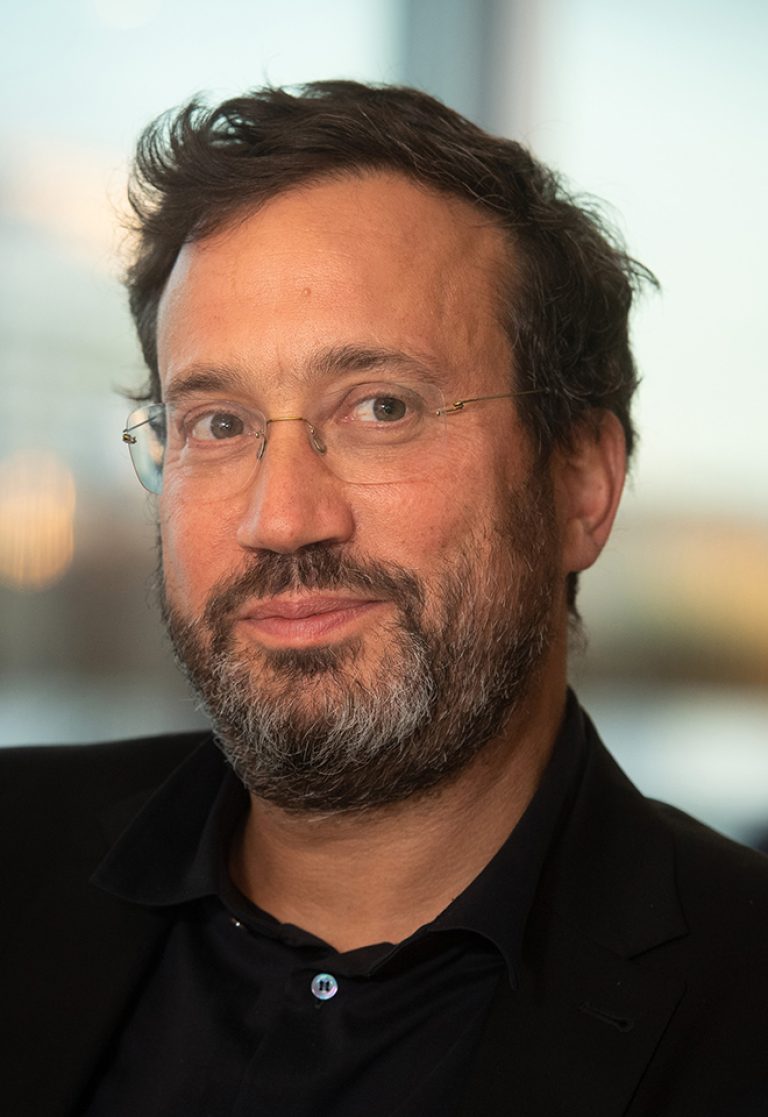
© David Ausserhofer / Robert Bosch Academy

Forensic Architecture es una agencia de investigación con sede en Goldsmiths, University of London. Nuestro mandato es desarrollar, emplear y difundir nuevas técnicas, métodos y conceptos para investigar la violencia estatal y corporativa. Nuestro equipo incluye arquitectos, desarrolladores, cineastas, periodistas de investigación, científicos y abogados. Somos una agencia interdisciplinaria que opera a través de los derechos humanos, el periodismo, la arquitectura, el arte y la estética, la academia y la ley; en 2022, el programa de los Premios Peabody escribió que habíamos co-creado «todo un nuevo campo académico y una práctica mediática emergente».

Sea Watch vs Libyan Coast Guard (with Forensic Oceanography) — An image projected onto a 3D model in order reconstruct the complicated scene of search-and-rescue operations by the Libyan Coastguard and NGO vessels on 6 November 2017. (Forensic Oceanography and Forensic Architecture, 2018)

Model Zoo — This rendered image of an armoured vehicle textured with random patterns is an ‘extreme object’. Machine learning classifiers that use rendered images of 3D models or «synthetic data” are known to improve when they are trained using extreme variations of the modelled object. (Forensic Architecture, 2020)

Airstrikes on M2 Hospital — There were a number of CCTV cameras in M2 Hospital that were continuously on, capturing every strike. Forensic Architecture located each camera and its orientation in the building in order to integrate footage from the CCTV cameras, handheld videos, and photographs within virtual space. (Forensic Architecture, 2017)

Police Brutality at the Black Lives Matter Protests — Selecting multiple filters lets a user compare violations across time and space. (Forensic Architecture and Bellingcat, 2020)

The Seizure of the Iuventa (with Forensic Oceanography) — By mapping the sky to the inside of a sphere, we track the motion of a mounted camera and match the drifting movements of the vessels in the scene. (Forensic Oceanography and Forensic Architecture, 2018)

Herbicidal Warfare in Gaza — A leaf from a local chard plant showing signs of possible herbicide damage after being sprayed in East Gaza. (Image: Shourideh C. Molavi)

The Beating of Faisal al-Natsheh — Superimposition of the models from the three witnesses we interviewed as they describe a convoy of soldiers escorting arrested Palestinian civilians to a militarised checkpoint in Hebron. (Forensic Architecture/Breaking the Silence, 2020)

A still image from the Conquer and Divide platform. (Forensic Architecture / B’Tselem)

Tear Gas in Plaza de la Dignidad — ‘Identifying clouds of tear gas’ The automated system helps identify the exact time and location of visible CS clouds. Analysis of teargas in Plaza de la Dignidad based on footage from Galería CIMA. (Forensic Architecture, 2020)

Chemical Attacks in Al Lataminah — Four debris fragments collected from Al Lataminah are turned into three-dimensional models, and recomposed inside our model of the M4000 bomb. (Forensic Architecture, 2019)

The Murder of Halit Yozgat — Simulated propagation of sound within a digital model of the internet café that was designed to mimic the exact dimensions and materials of the actual space. (Forensic Architecture and Anderson Acoustics, 2017)

Sea Watch vs Libyan Coast Guard (with Forensic Oceanography) — An image projected onto a 3D model in order reconstruct the complicated scene of search-and-rescue operations by the Libyan Coastguard and NGO vessels on 6 November 2017. (Forensic Oceanography and Forensic Architecture, 2018)

Model Zoo — This rendered image of an armoured vehicle textured with random patterns is an ‘extreme object’. Machine learning classifiers that use rendered images of 3D models or «synthetic data” are known to improve when they are trained using extreme variations of the modelled object. (Forensic Architecture, 2020)

Airstrikes on M2 Hospital — There were a number of CCTV cameras in M2 Hospital that were continuously on, capturing every strike. Forensic Architecture located each camera and its orientation in the building in order to integrate footage from the CCTV cameras, handheld videos, and photographs within virtual space. (Forensic Architecture, 2017)

Police Brutality at the Black Lives Matter Protests — Selecting multiple filters lets a user compare violations across time and space. (Forensic Architecture and Bellingcat, 2020)

The Seizure of the Iuventa (with Forensic Oceanography) — By mapping the sky to the inside of a sphere, we track the motion of a mounted camera and match the drifting movements of the vessels in the scene. (Forensic Oceanography and Forensic Architecture, 2018)

Herbicidal Warfare in Gaza — A leaf from a local chard plant showing signs of possible herbicide damage after being sprayed in East Gaza. (Image: Shourideh C. Molavi)

The Beating of Faisal al-Natsheh — Superimposition of the models from the three witnesses we interviewed as they describe a convoy of soldiers escorting arrested Palestinian civilians to a militarised checkpoint in Hebron. (Forensic Architecture/Breaking the Silence, 2020)

A still image from the Conquer and Divide platform. (Forensic Architecture / B’Tselem)

Tear Gas in Plaza de la Dignidad — ‘Identifying clouds of tear gas’ The automated system helps identify the exact time and location of visible CS clouds. Analysis of teargas in Plaza de la Dignidad based on footage from Galería CIMA. (Forensic Architecture, 2020)

Chemical Attacks in Al Lataminah — Four debris fragments collected from Al Lataminah are turned into three-dimensional models, and recomposed inside our model of the M4000 bomb. (Forensic Architecture, 2019)

The Murder of Halit Yozgat — Simulated propagation of sound within a digital model of the internet café that was designed to mimic the exact dimensions and materials of the actual space. (Forensic Architecture and Anderson Acoustics, 2017)