Events are an integral part of the master programs: from workshops with guests professors to lectures series with relevant practitioners.
Wed, Nov 4, 2026
Masters’ Talks
7.30 pm — Event at DHub
Open to the public

Izaskun Chinchilla
Los barrios del buen vivir: A Perspective from Tentative Design
Los barrios del buen vivir: A Perspective from Tentative Design
What if designers made fewer mistakes if they stopped trying to get it right the first time? Neighborhoods of Good Living explore a city understood not as a finished object, but as a living laboratory: spaces that are tested, inhabited, evaluated, and transformed. The lecture will explore the work of Izaskun Chinchilla Architects and the book Neighborhoods of Good Living to ask what happens when design abandons certainty and embraces hypothesis, experimentation, and adaptation. A perspective from tentative design to conceive of well-being as something experienced collectively.
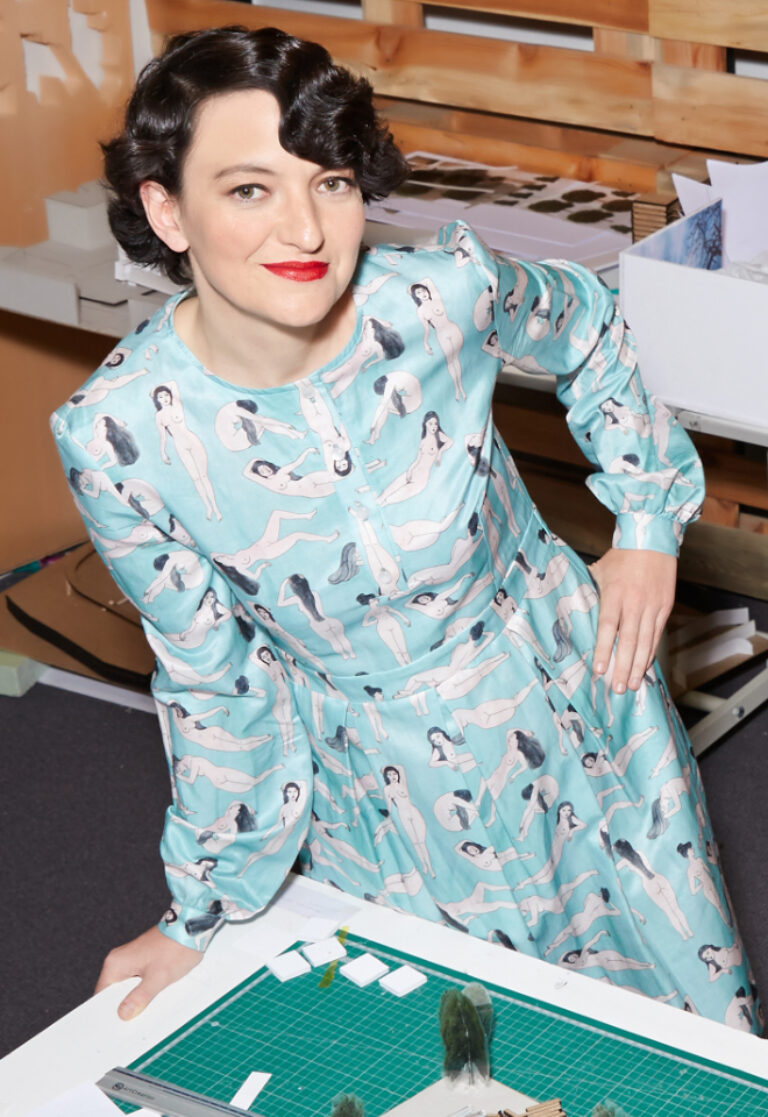
Izaskun Chinchilla, a professor at the Bartlett School of Architecture, University College London (UCL), and an honorary fellow of the Royal Institute of British Architects (RIBA), integrates ecology, care, and participation into her practice, research, and teaching. Her work promotes more equitable and sustainable cities. She combines design, critical thinking, and cultural knowledge to promote an architecture that is educational, cooperative, and oriented toward the common good. She is the author of La ciudad de los cuidados (Catarata, 2021) and Los barrios del buen vivir (Catarata, 2026).
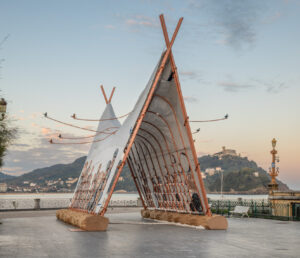
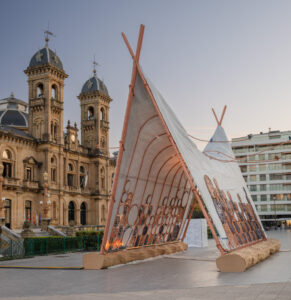
Izaskun Chinchilla Architects is a group of architects led by Izaskun Chinchilla that brings together interdisciplinary teams for each project. Their work focuses on optimizing the environmental performance of architecture, public space, facilities, art, and cultural products through innovation. Public engagement and social participation are pillars of their practice, which promotes collaboration in the construction of shared spaces and community-based decision-making regarding the use, location, and characteristics of the facilities they design.


past events
Wednesday,
January 25, 2023
7.30 pm

Luna Maurer, Moniker
Masters’ Talks
Rewind and fastforward
Rewind and fastforward
Luna Maurer will elaborate on Moniker’s relation with technology in the past 20 years and its impact on their practice. Moniker is currently developing a new outlook and perspective on technology, sparked by recent rapid developments in the field. The web changed from an emancipating democratizing network into an infrastructure for big capital, the screen from a desktop publishing interface to a fundamental extension of our identity. Luna will share their latest experiments.

Luna Maurer is an interaction and media design artist. Originally from Stuttgart (Germany), she completed her studies at the Gerrit Rietveld Academy and the Sandberg Institute in Amsterdam.
With Roel Wouters she heads the Amsterdam based studio Moniker. Moniker is well known for authoring the Conditional Design Manifesto (together with Edo Paulus and Jonathan Puckey). Luna Maurer has been teaching media courses at the Gerrit Rietveld Academy, the Sandberg Institute, Royal Academy of Art, The Hague, HfG Karlsruhe and at Yale University School of Art.
Moniker explores the characteristics of technology and its influence on our daily lives. They have designed many participatory projects (online and offline), as well as other web projects, films and performances. Their clients range from cultural institutions like Stedelijk Museum, Amsterdam and Fondation Beyeler, Basel to more technology oriented clients like the Mozilla Foundation, Unity 3D and Google.
Moniker has won many awards, including a British Music Video Award, a Webby, several Dutch Design Awards and the Amsterdam Prijs voor de Kunst.


Wednesday
November 30, 2022
7.30 pm

Viviane Stappmanns, Vitra Design Museum
Masters’ Talks
Curating for the Common Good
To curate means to care. Literally. In the case of design, these objects – and the exhibitions they are featured in – talk about the human drive for progress, about creative leadership, about material economies and technological innovations. But what does it mean to curate within the field of design in the 21st century? How can exhibitions and books make a contribution to fostering more just, socially and ecologically sustainable societies? In her lecture, she will provide insights into the hands-on practice of curating, and into the broader issues that may inform how we present, discuss and practice design in the future.

Viviane Stappmanns is a curator at the Vitra Design Museum in Weil am Rhein. She is interested in exploring the contribution curators can make to rethinking design as a practice concerned with ecological and social sustainability. In her exhibition and teaching work, she experiments with new, collaborative approaches to curating and exhibiting. She has taught at different schools and universities, among them the School of Architecture and Urban Design at RMIT University in Melbourne, Australia and, most recently the University of Arts and Design in Karlsruhe.
Prior to working at the Vitra Design Museum, Viviane has worked as an editor and curator within architecture and design contexts in Australia and Germany, and holds degrees in Interior Design and Journalism.
The exhibition “Here We Are! Women in Design 1900 – Today!” (2021) will open at the Barcelona Design Museum in October 2023. Currently, she is working on the international travelling exhibition “Garden Futures”, due to open at the Vitra Design Museum in Spring 2023.


1 & 2 — Exhibition «Typology. An ongoing study of everyday items», 2020 / 3 — Exhibition «Beyond the Surface», 2018 / 4 — Installation of the exhibition «Better Nature», 2019 / 5 & 6 — Exhibition «Here We Are! Women in Design», 2021 / 7 — Preparing the exhibition « Here We Are! Women in Design », 2021
March 8 → 12, 2021

Irene Pereyra, Anton & Irene
Masters’ Interdisciplinary Workshops
Barcelona 2.0
Open to all Master students
Barcelona 2.0
The aim of this workshop is to come up with a way that could improve Barcelona public life.
Each team will choose an existing item or service to improve—like for example trash collection, the metro, bicing, etc.
At the end of the week, each team will present their “upgraded Barcelona 2.0” idea. The final solution can be as realistic or fantastical as you would like it to be and can be presented and explained in the material or software of your choosing.
We will be getting to the solution by going through a variety of creative thinking exercises that will encourage participants to let their imaginations run wild by dreaming up the most unattainable, extreme, and impractical solutions you can think of in order to come up with a final solution. The goal of the workshop is to dig deep into how we come up with creative solutions, and understand the tools and processes available that are proven to tap into our creativity so you can apply these techniques to solve any kind of design problem you might encounter in the future.

Irene Pereyra
Co-founder of the Brooklyn based design studio “Anton & Irene”. She has led the strategy and UX initiatives for relevant clients for both the web and cross-platform applications. Her work has been recognized by numerous awards.
Irene has been a guest speaker at numerous conferences such as OFFF and FITC, and has lectured at SVA in New York, Hyper Island in Stockholm, Harbour.Space in Barcelona, and the Design Academy in Eindhoven. Her personal projects have been shown around the world.


March 8 → 12, 2021

Martí Guixé, Seeds
Masters’ Interdisciplinary Workshops
Seeds
Seeds
The aim of the workshop is to develop strategies, objects or actions around the seed element and in relation to issues such as reforestation, gardening, conservation, politics and food.
To understand how design can be with nature and not only against nature.

Martí Guixé comes from the background of every good designer, with an academic curriculum to his credit and work done with famous firms. But as revolutionaries today are born within the institutions that trained them, he revolutionizes design by working on living matter, that can be transformed and decomposed, hybridizing such areas as anthropology, humour, gastronomy, typography, the human sciences, exact sciences, performance, design.
He analyses situations, behaviour and gestures and proposes radically effective solutions with minimal ergonomics, liberated from the image of an idealized body where technocratic perspective tried to create the right form. As a visionary he transforms things with his eyes that observe them and invents the indispensable commodities of the twenty-first century.


October 14
↳ December 22, 2020
Elisava Àgora + Atri

Vladan Joler, Explorer of Contemporary Phenomena
Exhibition
Vladan Joler, Explorer of Contemporary Phenomena
Prof. Vladan Joler
[b. 1977] Is an academic, researcher and artist whose work blends data investigations, counter cartography, investigative journalism, writing, data visualization, critical design, and numerous other disciplines.
He explores and visualizes different technical and social aspects of algorithmic transparency, digital labor exploitation, invisible infrastructures, and many other contemporary phenomena in the intersection between technology and society.
Vladan Joler’s work is included in the permanent collections of the Museum of Modern Art, New York (MoMA), the Victoria and Albert Museum (V&A) and Design Museum in London and included in the permanent exhibition of Ars Electronica Center.
Aside from his permanent professorship position, i.e. tenure, at the Academy of Arts in Novi Sad, Serbia, where he teaches at the New Media department, he has given lectures at numerous educational and art institutions.

Explorer of Contemporary Phenomena
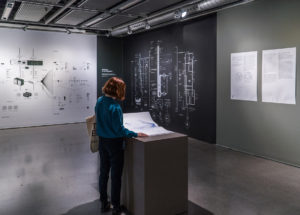
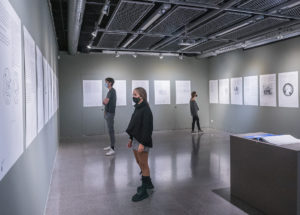
Three recent works are on display at Elisava: Anatomy of an AI System, 2018, A large-scale map and a long-form essay (in collaboration with Kate Crawford) investigating the human labor, data, and planetary resources required to build and operate an Amazon Echo. Awarded Design of the Year 2019 by the Design Museum, London. And two new works from 2020: The Architecture of a Face Recognition System and New Extractivism. It is the first time these works are exhibited in Barcelona.




Wednesday,
November 18, 2020
6.30 pm
Vladan Joler + Bani Brusadin
Open Talk
Vladan Joler, Explorer of Contemporary Phenomena
Prof. Vladan Joler
[b. 1977] Is an academic, researcher and artist whose work blends data investigations, counter cartography, investigative journalism, writing, data visualization, critical design, and numerous other disciplines.
He explores and visualizes different technical and social aspects of algorithmic transparency, digital labor exploitation, invisible infrastructures, and many other contemporary phenomena in the intersection between technology and society.
Vladan Joler’s work is included in the permanent collections of the Museum of Modern Art, New York (MoMA), the Victoria and Albert Museum (V&A) and Design Museum in London and included in the permanent exhibition of Ars Electronica Center.
Aside from his permanent professorship position, i.e. tenure, at the Academy of Arts in Novi Sad, Serbia, where he teaches at the New Media department, he has given lectures at numerous educational and art institutions.
A dialogue between Vladan Joler and Bani Brusadin
Together they will explore Joler’s rather fascinating character at the intersection of research, data visualization, cartography and art.
Among other topics, they will discuss together on how to visualize different technical and social aspects of algorithmic transparency, digital labor exploitation, invisible infrastructures, and many other contemporary phenomena in the intersection between technology and society.