
The Garden of the Human Echoes
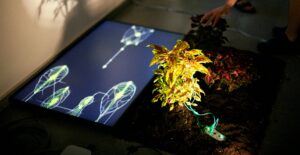
The Garden of the Human Echoes
Master Project
- MAIAD 26
The Garden of the Human Echoes is a project that exposes the anthropocentric bias embedded in generative diffusion models and attempts to subvert it by building an artifact in which human authorship is removed as far as the technology allows. Through systematic testing, the project begins by demonstrating that these models impose human ways of seeing onto every image they produce, regardless of instruction. It then proposes an alternative in the form of an installation in which a living plant authors its own representation.
Using a Playtronica Biotron, the plant’s bioelectrical and light signals are translated simultaneously into a generative text prompt and sound, whose waveform becomes the visual input for a real-time generative process. The outcome establishes whether anthropocentric bias in diffusion models is structural rather than superficial, tests whether a living organism can be placed in the position of author. The objective, put plainly, is to make the invisible process behind these systems visible and to open a conversation about what anthropocentrism in AI actually means.
A living plant is connected to a Playtronica Biotron via alligator-clip electrodes on a leaf or stem. The device continuously reads two signals — the plant’s bioelectrical resistance and the ambient light level — and streams them to a computer as MIDI over USB. A Python script normalises these values to a 0.0–1.0 scale.
The normalised signals drive a text prompt. A fixed vocabulary schema maps each channel to three registers — low (0.0–0.3), mid (0.3–0.7), and high (0.7–1.0) — using scientific terms drawn from plant-signalling and photosynthesis research (e.g. resting membrane potential, systemic depolarisation, photon scarcity, photoinhibition threshold). The plant’s signal selects the register; within it, specific words are chosen at random, seeded by the plant’s own raw MIDI value. This is combined with fixed anti-representational terms and a negative prompt that blocks the model’s default visual tendencies.
Simultaneously, the bioelectrical signal is rendered as live audio, producing a waveform that is a direct acoustic translation of the plant’s electrical state. That waveform is visualised and fed into StreamDiffusion as the incoming image source.
StreamDiffusion then transforms this waveform image in real time, steered by the plant-driven prompt. The output image emerges from the interaction of all three inputs -the electrical activity, its translated sound, and the generative model. The system runs continuously, updating as the plant’s state changes, so it functions not as a series of discrete images but as a live, ongoing visual process.


author/s